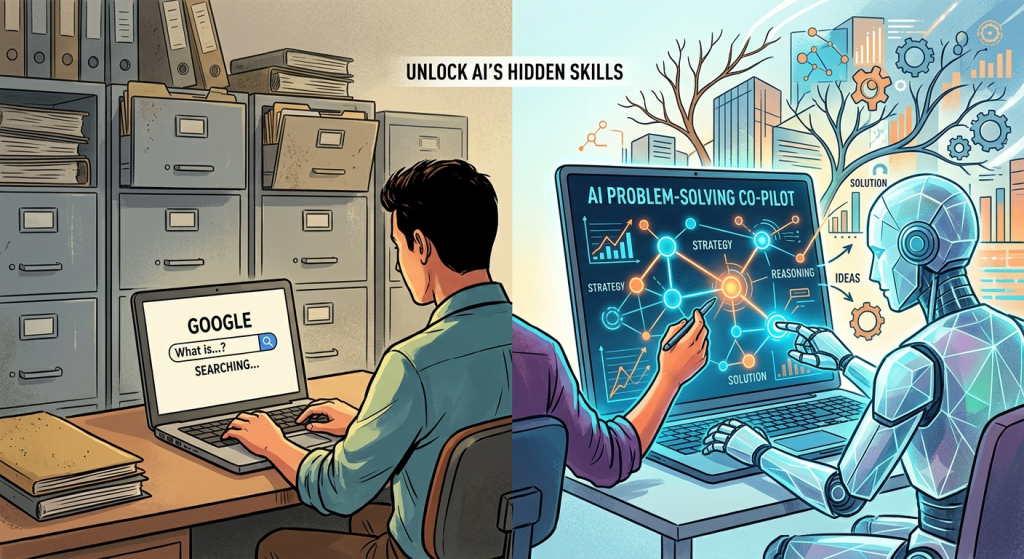
If you peeked over the shoulder of the average person using AI today, you would see a lot of people treating a multi-billion-dollar cognitive engine like a slightly faster version of Google.
They type in a question: “What are the main causes of the fall of Rome?” or “Give me a recipe for chicken parm.” The AI spits out a perfectly fine answer, the user copies and pastes it, and everyone moves on. There’s nothing inherently wrong with this, but using an advanced Large Language Model (LLM) just to look up facts is like buying a Ferrari and only driving it back and forth down your driveway. You are completely missing what the machine was actually built to do: solve problems.
If you want to unlock the real power on your screen, you need to break the “Google Habit” and start treating AI like a collaborative colleague, not a search bar.
Search Engines Fetch. AI Figures It Out.
To understand why the Google approach fails with AI, we have to look at how they handle information differently.
- Google is a filing cabinet. It looks at your keywords, scans the internet for pages containing those keywords, and hands you the folders. It requires you to do the reading, synthesizing, and problem-solving.
- AI is a sounding board. It doesn’t just hold information; it understands relationships between concepts. It can take messy, unorganized variables and help you puzzle through them.
When you treat AI like a search engine, you miss out on its ability to reason, stress-test ideas, and build custom frameworks from scratch.
3 Frameworks to Unlock AI’s Problem-Solving Brain
To move past the search bar mentality, try using these three advanced collaborative workflows.
1. The “Interactive Interview” Technique
Most people try to write the perfect, massive prompt on the first try. Instead, turn the tables and have the AI interview you. This is incredibly useful for complex tasks like business planning, coding, or organizing a massive project.
The Prompt: “I want to launch a weekend newsletter about local hiking trails in Southern California. I want you to act as a veteran media strategist. Do not write the plan yet. Instead, ask me 5 targeted questions one at a time to gather the context you need to build the ultimate strategy.”
By forcing the AI to ask the questions, you uncover blind spots you hadn’t even considered, resulting in a hyper-customized strategy.
2. The “Devil’s Advocate” Framework
We all suffer from confirmation bias. When we have an idea, we look for reasons why it will work. AI is the ultimate, emotionless tool for telling you why your idea might fail—without hurting your feelings.
| The Google Approach | The Problem-Solving Approach |
| “How do I market an online course?” | “Here is my plan to market an online course [insert plan]. Act as a cynical venture capitalist and pick 3 major holes in this strategy. Tell me exactly where it will fail.” |
| The Result: A generic list of marketing tips (SEO, social media, ads) that you already know. | The Result: A ruthless, practical critique highlighting where your budget is exposed or where your messaging is weak, allowing you to fix it before you launch. |
3. The “Chain of Thought” Debugger
When faced with a complex problem—whether it’s a bug in a line of code, a broken Excel formula, or a interpersonal conflict at work—don’t just ask for the solution. Ask the AI to show its work before it gives you the answer.
Forcing the AI to think step-by-step drastically reduces “hallucinations” (errors) and teaches you how to solve the problem next time.
- Try adding this to the end of a hard prompt: “Before giving me the final answer, break down your reasoning step-by-step and list any assumptions you are making.”
From Search Bar to Subcontractor
The shift from “Google searching” to “AI collaborating” is entirely mental. It requires you to stop thinking of the AI as a database and start thinking of it as a highly capable, infinitely patient assistant sitting across the desk from you.
Don’t just ask it what something is. Ask it how to fix it, why it’s broken, and what you might be missing. That’s when the magic happens.
Leave a Reply