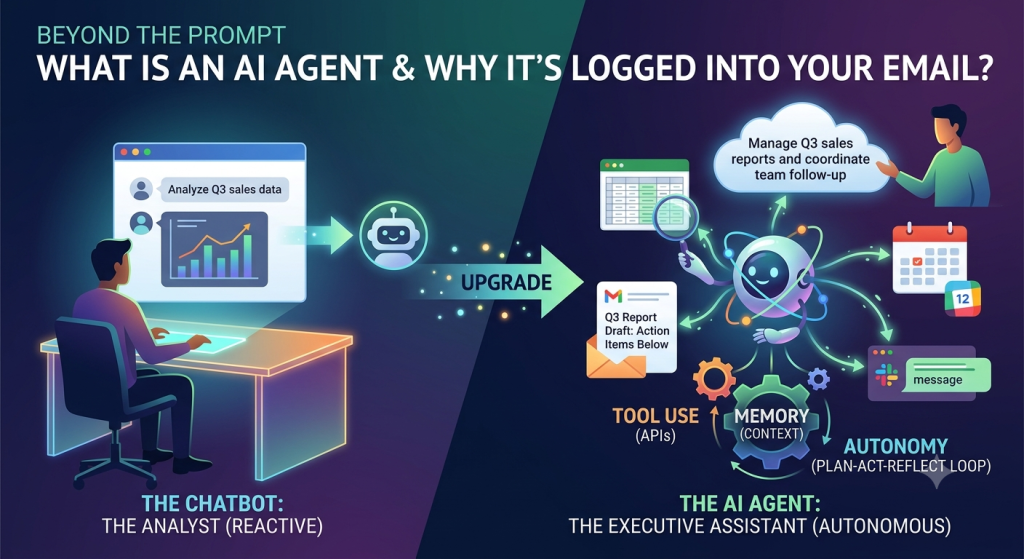
For the past few years, our relationship with artificial intelligence has followed a very specific, predictable rhythm. You open a clean white browser window, you type a prompt into a text box, you wait five seconds, and a chatbot spits out text, code, or an image.
It’s an impressive parlor trick, but it requires you to be the engine. The moment you stop prompting, the AI stops working. It is entirely reactive.
But behind the scenes, the tech landscape has undergone a massive, quiet shift. We are officially moving out of the “Chatbot Era” and entering the “Agentic Era.”
If you’ve noticed recent software updates requesting permission to not just read your emails, but draft replies, manage your calendar, or interact with external apps on your behalf, you are seeing the arrival of AI Agents.
So, what exactly is an agent, how does it differ from the chatbot you’re used to, and why are we handing them the keys to our digital lives?
Chatbots vs. Agents: The Executive Assistant Upgrade
To understand the difference, imagine you are running a business and you have two different types of assistants.
- The Chatbot is an Analyst. If you ask them, “What are the best flight options from New York to London next Thursday under $800?” they will instantly look up the data, analyze the options, and present you with a beautiful summary. But then they stop. They cannot book the flight for you. You still have to open your laptop, enter your credit card, and type in your passport number.
- The AI Agent is an Executive Assistant. You give them a single high-level goal: “I need to be in London next Thursday for a client dinner. Keep the total travel budget under $1,500.”
The agent doesn’t just look up flights. It opens your calendar to check your availability, cross-references your airline point balances, books the optimal ticket using your secure corporate card, reserves a table at a highly-rated restaurant near the client’s office, and sends a calendar invite to the client. It handles the messy middle steps without asking you for permission at every single turn.
The Three Pillars of an Agent
How does an AI make the leap from a simple text generator to an autonomous worker? It relies on three core architectural pillars:
1. Tool Use (Function Calling)
Standard chatbots are trapped inside their own web tabs. Agents, however, are given hands. Through secure software connections (APIs), an agent can interact with the digital world. It can open Google Sheets, send a Slack message, calculate a budget using a Python script, or navigate a website just like a human user would.
2. Memory (Short-Term and Long-Term)
If you start a new chat with a standard bot, it completely forgets who you are. An agent utilizes persistent memory. It remembers that you prefer window seats on flights, that you hate corporate jargon in your emails, and that your highest-priority client is based in Chicago. It uses past interactions to inform future autonomous decisions.
3. Autonomy (The Reflection Loop)
This is the secret sauce. When you give an agent a complex task, it doesn’t just generate a blind response. It creates a step-by-step plan, executes step one, evaluates the result, and corrects its own course if something goes wrong.
Plaintext
[Goal: Schedule Meeting] ➔ Agent Checks Calendar ➔ Context: Conflict Found! ➔ Agent Autonomously Emails Client to Propose Alternative Time
Why Is It Logged Into My Email?
The reason tech companies are aggressively pushing agentic integration into your workspace (like email, CRM software, and project management tools) is because email is the nervous system of modern business.
An agent sitting inside your inbox can act as an automated triaging system. It can scan an incoming email from a vendor, recognize that an invoice is attached, verify the invoice against your contract in Google Drive, draft an approval response, and queue up the payment—all while you’re asleep.
The “Agentic” Comfort Level
It is completely natural to feel a little uneasy about turning a machine loose in your inbox or calendar. We’ve all seen AI make bizarre logical errors, and giving an autonomous entity access to real-world actions feels risky.
That’s why the transition won’t happen overnight. We are currently in the “Human-in-the-Loop” phase. For the next year or two, agents will operate like co-pilots: they will do 90% of the pulling, digging, and drafting, but they will pause and present a giant “Approve” button before actually sending an email or spending a dollar.
AI may not be dumb, but it is finally becoming independent. The days of treating AI like a novelty search engine are drawing to a close. Soon, we won’t be managing our tools; we’ll be managing our staff.
Leave a Reply