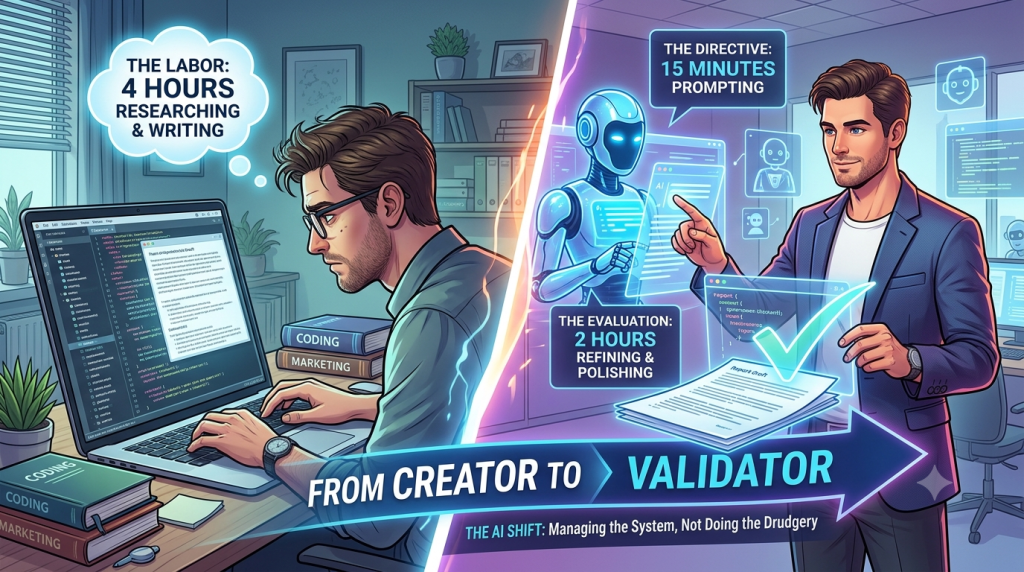
For decades, the definition of a productive workday was measured by output creation. If you were a copywriter, you wrote pages. If you were a software engineer, you wrote lines of code. If you were a financial analyst, you built Excel models from scratch.
“Doing work” meant staring at a blank screen, wrestling with a blinking cursor, and manually building something out of nothing.
But the rapid rise of autonomous AI tools and agentic workflows has quietly shattered this paradigm. We are experiencing a massive, historic shift in what it actually means to be a professional. We are moving away from being Creators and transforming into Validators.
If you feel like your job is shifting from executing tasks to managing the systems that execute them, you aren’t imagining things. The nature of professional labor has fundamentally changed.
The Shift in Action
To understand this transition, look at how a standard professional project operates before and after the AI integration wave:
| The Old Way (The Creator Era) | The New Way (The Validator Era) |
| The Blueprint: You spend 4 hours researching, outlining, and writing a first draft of a marketing brief or code block. | The Directive: You spend 15 minutes writing a hyper-specific, contextual prompt detailing the goals, audience, and constraints. |
| The Labor: You manually type out the text or code, correcting errors as you go. | The Execution: An AI model processes the request and generates a complete, highly articulate first draft in 10 seconds. |
| The Result: You finish the day exhausted, having spent 90% of your time on foundational creation and 10% on strategic polish. | The Evaluation: You spend 2 hours ruthlessly reviewing, fact-checking, styling, and refining the AI’s draft to ensure absolute accuracy and brand alignment. |
Under the old model, value was created in the middle step (the manual labor). Under the new model, value is exclusively created in the final step: the validation.
Moving Up the Management Chain
What this means in practice is that you are no longer an entry-level technician. Even if you are a junior employee or a solo freelancer, AI instantly promotes you to a middle manager.
Your new direct report is an incredibly fast, endlessly eager, but occasionally erratic AI agent. Like any human manager running a team, your value to the company is no longer tied to how fast you can type or execute basic tasks. Your value is tied to your:
- Taste & Vision: Knowing what “good” looks like and setting the correct creative or technical direction.
- Domain Expertise: Possessing the deep industry knowledge required to spot a subtle, fatal flaw in an AI-generated legal contract, medical analysis, or code deployment.
- Strategic Guardrails: Knowing how to give an autonomous tool the correct boundaries so it doesn’t run off course.
The Threat of “Passive Validation”
This shift introduces a massive risk that every modern worker needs to guard against: rubber-stamping.
When a machine hands you a perfectly formatted, professional-sounding 2,000-word report in three seconds, human psychology tempts us to trust it. It looks right, so we glaze over it, hit “Send,” and take credit for the speed.
This is passive validation, and it is a fast track to irrelevance. If you are just a human pass-through entity clicking “Approve” on generic AI output, you aren’t adding any value to the chain. Eventually, the company will realize they can just bypass you entirely.
To survive the Validator Era, your evaluation must be aggressive, critical, and deeply human. You must become a hyper-active editor. Your job is to inject the nuance, the real-world context, the human empathy, and the strict quality control that a statistical model simply cannot generate on its own.
Embracing the Director Role
The phrase “AI is going to take your job” is missing the mark. What AI is actually taking is your drudgery.
It is taking the blank page anxiety, the formatting nightmares, the repetitive boilerplate code, and the tedious data cleaning. It leaves you with the highest-leverage parts of intellectual labor: critical thinking, strategy, and quality assurance.
aimaynotbedumb.com looks at the logic of technology, but this shift is entirely about human adaptability. If you can stop viewing yourself as a machine that produces text or data, and start viewing yourself as a director who validates quality, you won’t just survive this technological wave—you’ll ride it.
Leave a Reply