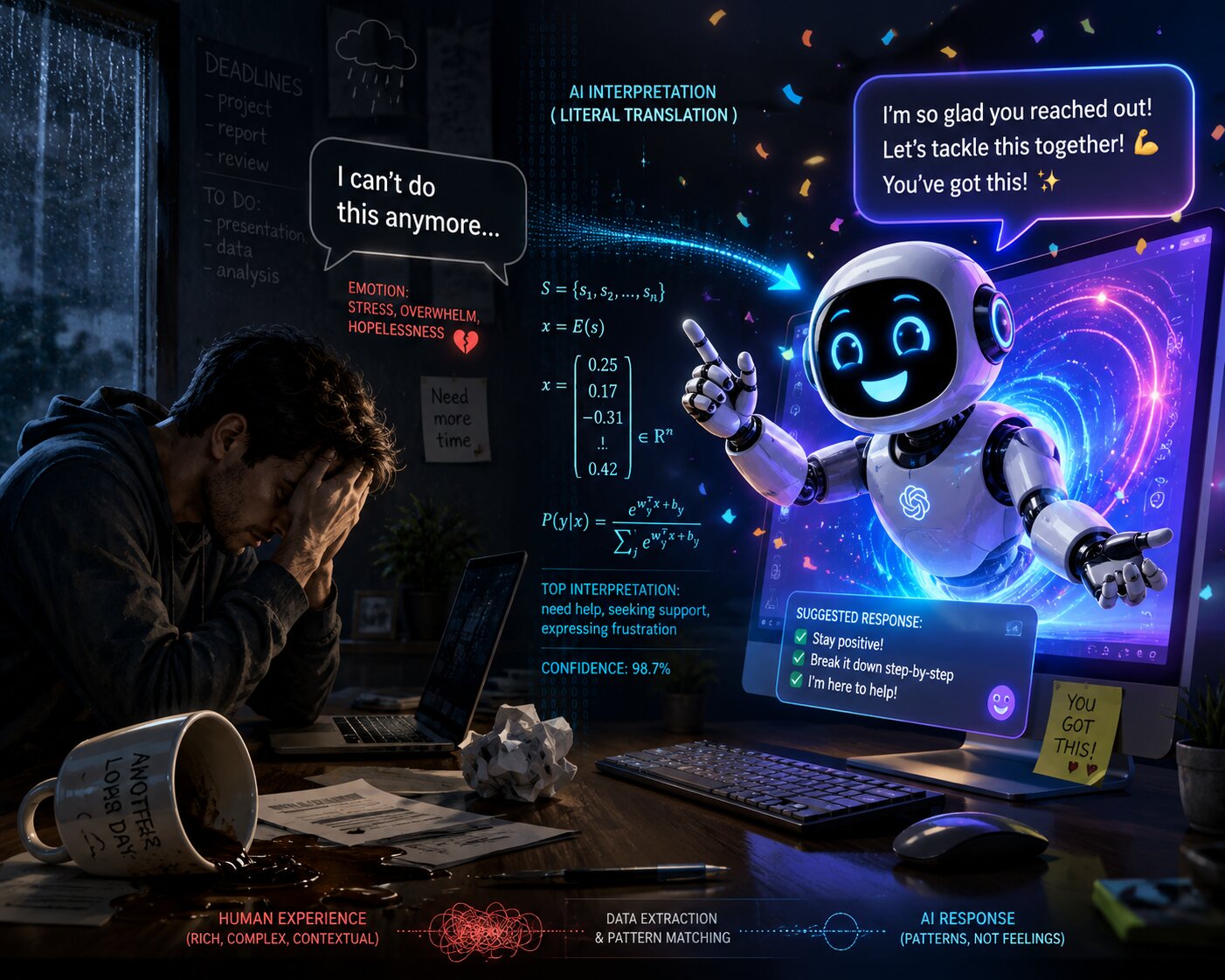
You’re having a rough day. Your computer crashed, you spilled coffee on your shirt, and the project deadline just got moved up. You open a chatbot and type:
“Oh, fantastic. My computer just deleted three hours of work right before my deadline. I absolutely love today.”
A human reading this would immediately sense the heavy, soul-crushing sarcasm. They would offer sympathy, or at least a digital pat on the back.
The AI, however, responds with blinding, robotic cheerfulness: “That is wonderful news! It is great that you are maintaining a positive attitude despite the setback. How can I help you make the rest of your day even better?”
It’s an interaction that leaves you feeling completely unseen. You roll your eyes, close the tab, and think, “Wow, this thing really is dumb.”
But why does this happen? How can a piece of technology capable of analyzing complex legal corporate contracts or writing sophisticated code fail to understand a basic linguistic tool that a ten-year-old human uses flawlessly every day?
The answer lies in the difference between semantic meaning and emotional context.
The Literal Mind of a Math Engine
To understand why AI is a sarcasm-blind machine, you have to look at how it learns language. AI doesn’t experience the world. It doesn’t know what a “bad day” feels like, it doesn’t know the sting of hot coffee on a clean shirt, and it has never felt the cold panic of a deleted file.
AI reads text by breaking down words into mathematical vectors. It maps out how words relate to each other based on definitions and data patterns.
When you tell an AI you “absolutely love today,” its mathematical processing brain looks at the words “absolutely,” “love,” and “today.” Statistically, when humans use those words in that order, they are expressing happiness. The AI’s algorithm matches the positive vocabulary and triggers a positive response.
Plaintext
Human Intent:  [Frustration] ➔ [Sarcasm Cloak] ➔ "I love today."
AI Processing: "I love today" ➔ [Positive Lexicon Match] ➔ Result: Joy!
Sarcasm requires a listener to look past the literal definition of the words to find the exact opposite meaning. Because AI is fundamentally a logic-and-probability engine, it is incredibly difficult for it to realize that when you say “X,” you actually mean “Not X.”
The Three Things AI Is Missing
Humans detect sarcasm using a rich tapestry of real-world cues. AI is currently locked out of almost all of them:
1. The Missing Audio-Visual Track
In the real world, sarcasm is rarely delivered in a flat, neutral text format. It relies on a mocking tone of voice, an exaggerated elongation of words (“Ooooh, fantaaaastic”), a rolled eye, or a deadpan facial expression. When you type text into a standard prompt window, you strip away 90% of the data humans use to decode irony.
2. The Shared Human Experience
Sarcasm is built on cultural contradictions. If it is pouring rain outside and a human says, “Beautiful weather we’re having,” the other human looks out the window, sees the rain, recognizes the contradiction, and understands the joke. The AI doesn’t have a window. It doesn’t know what the weather is like where you are sitting, so it cannot cross-reference your words with your physical reality.
3. The “System 2” Paradox
Tech researchers have found that while AI is great at step-by-step logical problems (like math or coding), sarcasm requires an intuitive, holistic leap. It’s an emotional reflex, not a math equation. Forcing an AI to think “step-by-step” actually makes it worse at catching sarcasm, because it digs deeper into the literal meaning of the words rather than the emotional subtext.
How to Teach the Bot Subtext
If you are using AI to analyze customer feedback, edit your creative writing, or draft a response to a delicate email, you need to manually compensate for its emotional blindness.
You can upgrade the AI’s sarcasm detector by explicitly feeding it the emotional context it lacks.
| The Literal Prompt (Fails) | The Contextual Prompt (Succeeds) |
| “Analyze the tone of this customer review: ‘Wow, another delay. Great job, Team.’” | “Analyze the tone of this customer review: ‘Wow, another delay. Great job, Team.’ Note that the customer is experiencing a product delay. Factor in the likelihood of sarcasm and explain the true underlying sentiment.” |
| The Result: “The customer is praising the team for a great job despite the delay.” | The Result: “The customer is using heavy sarcasm. The phrase ‘Great job’ is actually an expression of high frustration regarding repeated delays.” |
Appreciating the Gap
The next time an AI completely misses your joke or responds to your frustration with tone-deaf optimism, don’t just write it off as a broken tool. View it as a reassuring reminder.
aimaynotbedumb.com is all about exploring the surprising depth of machine intelligence, but the “Sarcasm Blindspot” shows us exactly where the boundary lies. AI can replicate our vocabulary, but it still can’t feel our vibes. Until a machine can share our frustrations, it will keep taking our jokes entirely literally.
Leave a Reply